


AI-powered communication is quickly becoming essential to meeting customer expectations at scale. Production voice agent implementations grew 340% year-over-year across 500+ organizations, with 67% of Fortune 500 companies now running production voice AI systems. And the returns are real: companies using AI voice agents report a 3-year ROI between 331% and 391%.
Likewise, AI texting is rising in popularity. 81% of consumers check their text messages within five minutes of receiving them, and 98% of texts are read. For outbound outreach specifically, texting is a high-impact channel: SMS response rates are 295% higher than phone call response rates, as 80% of people do not pick up the phone for numbers they don’t know.
AI voice and texting represent a new standard for how businesses talk to leads and customers at scale. These two types of AI outreach have different use cases, strengths, and weaknesses.
We’ll go over how AI voice agents or AI texting agents work, how they differ, and which one is the right fit for your business (hint: it could be both).
What are AI voice agents?
An AI voice agent is an AI-powered software system that can hold real, natural phone conversations with leads or customers. Powered by large language models (LLMs) and advanced speech technology, they leverage AI voice technology that sounds human. Today’s AI voice agents can understand what someone is saying, respond naturally, pick up on tone, and take action, all in real time on a phone call.
Unlike older phone systems that trapped callers in rigid menus, modern AI voice agents have real conversations. They can handle follow-up questions, topic changes, and pushback the way a skilled rep would. Leading speech-to-speech implementations now achieve round-trip latencies of 300–500ms, which is on par with natural human conversation.
Highly scalable, AI voice agents are available 24/7 and can handle hundreds of calls at once.
A real-world example: A homebuilder gets inbound calls after hours from buyers who have questions about floor plans, pricing, and lot availability. Instead of sending those callers to voicemail, an AI voice agent picks up, answers common questions, gauges the buyer’s timeline and budget, and schedules an appointment with a sales rep.
How does AI texting work?
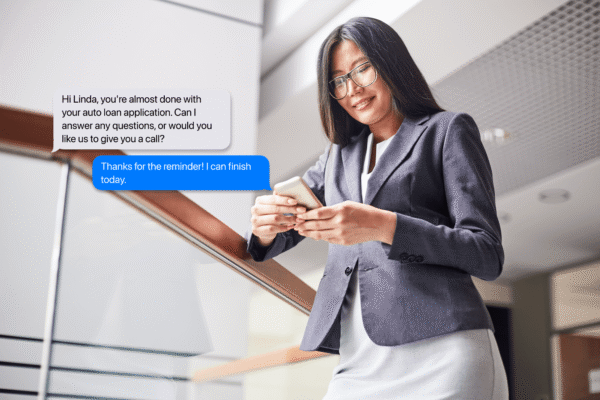
AI texting, also called conversational AI SMS, uses AI to have human-like, two-way conversations over text in real time. Texting AI agents understand natural language, so leads can text the way they normally would. The AI figures out what they’re asking, follows up with the right questions, qualifies them, answers FAQs, and can book appointments or hand off to a human when needed.
When a lead fills out a form, clicks an ad, or enters a campaign, an AI text agent can respond within seconds and carry the conversation from there.
Because texting is asynchronous, it fits naturally into how people communicate today. Leads don’t have to commit to a live conversation: they can reply from wherever they are, on their own schedule. This low barrier is what makes AI texting so effective.
A real-world example: A mortgage company runs paid ads that drive leads to a landing page form. The moment a lead submits, an AI text agent fires off a personalized message asking about their loan goals. The lead replies during their lunch break, the agent runs through a short qualification flow, and by the end of the thread, the lead has a call scheduled with a loan officer.

Key differences: AI voice agents vs. AI texting
While both are powerful AI tools, the channel they run on creates real differences in when and how they work best. Both types of AI can handle questions, lead qualification, after-hours engagement, and appointment setting. In practice, AI texting tends to be the better fit for initial inquiries and straightforward qualification flows, while voice AI shines for complex conversations where nuance matters.
Channel
AI voice agents run on the phone. AI texting runs over SMS, and increasingly RCS, which adds richer media and read receipts to standard texts. Both channels are available around the clock; however, a phone call is immediate and personal, while a text thread is low-pressure and flexible.
Synchronicity
Phone calls require active engagement. When a lead picks up, they’re in the conversation, and they can’t set it down and come back later. That real-time commitment can work in your favor when a lead is ready. AI texting is the opposite: asynchronous, on the lead’s timeline. They can reply during lunch, between meetings, or late at night. That flexibility makes text a much lower-friction entry point for a lot of prospects.
Speed
Both AI voice and text agents respond instantly. The difference is on the lead’s end: texting requires typing, which takes a little longer than speaking. That said, this isn’t always a drawback; plenty of people actively prefer typing, especially in professional settings or when they can’t take a call.
Understanding
Both types of AI use natural language processing to understand what customers are saying and respond intelligently. However, AI voice can detect sentiment: it can hear frustration, hesitation, or enthusiasm in someone’s tone. This matters a lot for objection handling and knowing when to escalate. Text-based AI can read between the lines through word choice, but unspoken cues are invisible.
Accessibility
Voice AI is a strong fit for visually impaired individuals who may struggle with text-based interfaces. AI texting is essential for people who are deaf or hard of hearing, for whom phone calls simply aren’t an option. Neither channel wins outright on accessibility. Truly accessible communication means offering both, giving people a way to engage on their own terms.
Comparison chart: AI voice vs. AI texting
Here is a comparison chart summarizing the key capabilities of each AI.
| Feature | AI voice | AI texting |
| Availability | 24/7, instant response | 24/7, instant response |
| Lead qualification | Qualifies through conversation | Qualifies through conversation |
| Appointment setting | Schedules via call | Schedules via SMS |
| FAQ handling | Answers via call | Answers via text |
| Natural language understanding | Understands speech | Understands text |
| Channel | Phone call | SMS and RCS |
| Synchronicity | Real-time: requires active engagement | Asynchronous: leads can reply on their schedule |
| Sentiment detection | Detects tone and emotion | Limited to word choice only |
| Friction to engage | Higher: requires picking up a call | Lower: easy to start texting |
| Accessibility | Good for visual impairment | Good for hearing impairment |
| Best funnel stage | Mid to bottom | Top to mid |
Where AI voice agents and AI-powered SMS fit in the funnel
Both channels can add value across the top and bottom of the funnel, but understanding the outbound vs. inbound dynamic helps clarify when to use each.

When to use voice AI
AI voice is most effective in two scenarios: inbound calls, and outbound to warmer leads.
For inbound, voice is a natural fit. Since the lead chose to call, they’re already ready to engage. An AI voice agent can handle that conversation end to end, answering questions, qualifying, and booking appointments without dropping the ball on response time.
For outbound, voice works best when there’s already a relationship or a clear signal of intent. For example, think of a lead who previously filled out a form and requested a call, someone mid-funnel who needs a follow-up, or a past customer due for a check-in. In these cases, the lead is expecting contact and more likely to pick up.
What voice AI is not great for: outbound to contacts who have not yet engaged with you. An unsolicited voice call can feel intrusive.
When to use AI texting
AI texting is the stronger channel for outbound, especially to new leads. The data is clear on this: SMS response rates are 295% higher than phone call response rates, and 80% of people don’t pick up the phone for numbers they don’t know. Meanwhile, SMS meets them where they already are and lets them respond on their own time.
When a lead fills out a form, their interest is at its peak, and speed matters. An AI text agent that responds within seconds captures that momentum before it fades. From there, it can run a qualification flow, answer questions, and schedule a call or appointment autonomously.
Text is also the right first move for any outbound campaign: re-engagement sequences, post-event follow-up, or new lead nurture. Once a lead responds and shows intent, that’s the natural handoff point to a voice interaction.
How to choose the right AI for your business
Ideally, businesses make both AI texting and voice available, letting leads engage through whatever channel they prefer. Consumer preference varies; some people will always pick up the phone, while others will never answer one. Meeting leads where they are isn’t just good customer experience; it’s a better revenue strategy.
That said, if you’re just getting started and need to prioritize, here’s a useful way to think about it:
If your business relies heavily on phone-based sales and your conversion model is built around calls, AI voice agents are a natural fit, as they plug into your existing motion without disrupting it.
If your qualification process is more straightforward, or if most of your leads come through digital channels like web forms or paid ads, AI texting may be the ideal choice. Text is the preferred contact method for a large share of consumers, especially for that first outreach, and it’s easier to get up and running at the top of the funnel quickly.
For example: Take an insurance agency that gets leads from multiple sources: online quote forms, referrals, and inbound calls. Leads from web forms tend to be earlier in the decision process and just browsing their options—at the same time, many of these leads are unqualified or just looking.
An AI text agent is perfect here: it catches them while interest is high, starts a low-friction conversation, and sifts through unqualified leads to find the leads that are qualified.
Inbound callers, on the other hand, are motivated, usually further along and ready to talk specifics. An AI voice agent handles those calls, answers coverage questions, and gets an appointment on the calendar.
In most cases, the two channels work better together than apart.
Combining voice and text agents for multi-channel AI engagement
 In reality, AI voice and texting are not competing options. Instead, they are a coordinated system for smarter customer engagement across channels. Omnichannel campaigns outperform single-channel by over 3x, and on average, buyers use six touchpoints during their decision-making process.
AI texting can handle the first touch: fast, low-friction, available the moment a lead shows interest. It qualifies, answers questions, and nurtures—all on the lead’s timeline. When the moment is right, it hands off to an AI voice agent for the higher-stakes conversation.
Running both channels also gives you something a single-channel approach can’t: the ability to meet every lead on their terms. Some leads will always prefer text. Others want to talk. A multi-channel AI system doesn’t force a choice. This approach drives higher engagement rates, more qualified conversations, and better outcomes across the funnel.
Deploy AI texting and voice agents with Verse
With Verse, you don’t have to choose. And you don’t have to build it from scratch.
Verse, now powered by NiCE Cognigy, allows teams to craft and deploy customized AI agents for sales and marketing that can be built in an afternoon. Designed for speed, our AI agent builder is an intuitive platform that doesn’t require deep technical expertise or months of implementation.
With Verse, leads can move from web chat to text to a voice call in one system, and the system reports the dollars it produced. That means full visibility into what’s working: which campaigns are driving qualified conversations, which channels are converting, and where leads are dropping off.
Verse’s AI agents span omnichannel: SMS and RCS, website chat, ringless voicemail, and AI voice calls. Leads engage through whatever channel works for them, and your team gets a unified view of every interaction.
Verse’s backend comes pre-built with trustContact, a compliance suite that covers TCPA regulations, A2P and 10DLC phone number registration.
Verse helps you connect with more engaged leads, qualify faster, better utilize human reps, and track revenue attribution. Whether you’re scaling a contact center or just trying to stop losing leads to slow follow-up, Verse gives you the infrastructure to compete across every channel at once.
Ready to learn more? Book a demo with Verse.
Key takeaways: AI voice agents vs. texting agents