


The way people communicate has changed a lot over the past few years. Email is still a valuable tool in the marketing arsenal, but it’s no longer necessarily the most valuable. Within the SMS vs. email debate, many businesses are finding that SMS delivers much better results for many types of customer engagement. That’s because SMS messaging boasts open rates of 98%, compared to less than 50% for email. This doesn’t mean that businesses should replace email entirely, but it does mean they need to reevaluate when SMS is the better option.
The Widening Performance Gap Between SMS vs. Email
As mobile phone use has become more ubiquitous and email spam filters have become more aggressive, the contrast between SMS vs. email performance has become more pronounced. Open rates show part of this equation, but don’t tell the whole story. Let’s examine some other ways SMS beats email.
Response Times
Unsurprisingly, the higher open rate of SMS also leads to a higher response rate. Verse research shows a 50% response rate for texts, with emails only seeing a 1.4% response rate.
SMS also boasts significantly faster response times. SMS responses come within 90 seconds on average, while email responses take hours or even days to arrive, when they arrive at all. This makes SMS the clear winner for any urgent communications.
Conversion Rates
The average email marketing conversion rate is around 15%, whereas the average SMS conversion rate ranges from 21% to 32%. Combined with the much higher open rate, this makes SMS a much better option for time-critical marketing activities, such as limited-time sales or new product launches, where a big first day drives future momentum.
Overload
The average professional receives 120 emails per day. This causes an inbox overload where even well-crafted emails struggle for attention. In the attempt to cut down on the clutter, spam filters have become more aggressive, often catching legitimate emails and redirecting them to folders where they’ll likely never be seen, further reducing engagement. Once again, when it comes to SMS vs. email, it’s easy to see how SMS becomes an important medium for urgent communications.
Why SMS Excels in Today’s Communication Landscape
We’ve seen quite a few statistics showing the superiority of SMS for customer communications. Let’s take a look at some of the reasons why those stats are what they are:
Psychology
There is a significant difference in the way people interact with their phones versus their email inboxes. Text messages trigger immediate notifications that people feel compelled to check. Given the email overload phenomenon, the same is not true for that communication method. The psychology of the average person says that email can wait for later.
Simplicity
SMS is much simpler than email. There are no elaborate HTML templates. There’s no need to worry about rendering across different email clients or crafting subject lines that get past spam filters and grab reader attention. Instead, a well-written SMS message delivers its core value immediately, without the need to download images or process complex formatting.
Ease of Communication
Two-way texting allows for quick and convenient exchanges that respect a customer’s time. Rather than composing formal emails or spending time on hold, customers can quickly send a question via text message and receive a response just as quickly. This allows for easy multitasking or seeking help while on the go, a convenience that directly translates to customer satisfaction and loyalty.
Evolving Customer Expectations
The importance of SMS will continue to grow as customer expectations change. We’re already seeing these movements across many categories:
Instant Gratification
The trend of expecting instant gratification is only growing. Customers get real-time updates from rideshare apps, instant confirmation from food delivery services, immediate notifications from their favorite brands, and GPS-level tracking from shipping carriers. These experiences have completely reset expectations across all business interactions.
Simple Communication
Society is also shifting towards simpler communication preferences. Social media prioritizes communication that gets straight to the point without the need to parse through lengthy content or complex formatting. SMS aligns naturally with these preferences with its concise, actionable information.
Mobile-first
Smartphones are the primary device for daily communication for a large portion of the population, especially the younger generations. SMS is a clear winner here, too. Being designed for mobile from the start, it provides a much better experience than emails, which require special consideration to look good on mobile devices.
Permission and Trust
Today’s consumers are much more conscious of how their data is used. When someone opts into SMS communication, they’re giving access to their most personal communication channel. This places responsibility on businesses while providing a great opportunity. Businesses that honor this trust with relevant and valuable messages can achieve remarkably high engagement rates and build more loyal customers.
Strategic Channel Selection: When To Use What
Email isn’t obsolete and shouldn’t be fully replaced by SMS. The key to building an effective marketing strategy is knowing when to use each channel.
SMS
For time-sensitive information such as urgent updates, appointment confirmations, delivery notifications, limited-time offers, quick surveys, and two-way customer service conversations, SMS wins easily. Text messages are immediate and highly visible, making them ideal whenever quick action or awareness is needed.
When comparing SMS vs. email, there are ways email excels. SMS is fast, but it’s necessarily short-form content. For many communication tasks, this is a benefit. But many marketing tasks benefit from the longer form or more complex formatting of email. This includes visual-heavy presentations, complex newsletters, and detailed receipts and documentation. Email is also perfect for content customers might want to reference later, and formal business communications.
Coordinating Both
The best marketing strategies understand how to combine the two communication channels to maximize the benefit of each. This might mean introducing a new product via email, where the format allows for detailed specifications and imagery, and then following up with SMS reminders when the product launches and sales are live. A medical provider might send a quick SMS for appointment confirmation, along with an email with detailed preparation instructions.
Rebalancing Your Communication Strategy

If you’re relying too heavily on email right now, you don’t want to haphazardly switch to SMS. Instead, take your time to decide which messages belong in which channel. This begins by looking at your current communications and picking out the ones that have the most urgency and the lowest open rates. These are prime candidates for SMS messaging. Appointment reminders, time-sensitive promotions, order updates, and customer service replies often perform dramatically better via text.
Before you can make the switch to the chosen messages, you’ll need to build your SMS subscriber list. Given the intimate nature of text messaging, you’ll want to pay even more attention to permission and value than you do for email. Your opt-in opportunities should be clear and compelling. Subscribers should know what they’ll receive and how often. Once you’ve built that trust, retain it by sending only messages with genuine value rather than excessive promotional content.
Customer segmentation and personalized content are also highly valuable in an SMS marketing effort. SMS messages are opened quickly because people allow the channel to interrupt their day. They won’t do this if they feel like it’s a generic message rather than something relevant to them. Instead, they’ll opt out, and you’ll lose the chance to convert them in the future. In addition to segmenting users based on what they’ll find interesting, it can also be beneficial to segment them based on whether they respond better to SMS or email.
How Verse Bridges Both Worlds for Maximum Impact
Verse enables businesses to get the best balance across all communication channels. The platform executes high-quality, customizable campaigns through text, phone, and email to create an omnichannel experience that meets customers where they are.
Conversational AI coordinates communication across channels to deliver qualified leads, book appointments, and drive revenue growth.
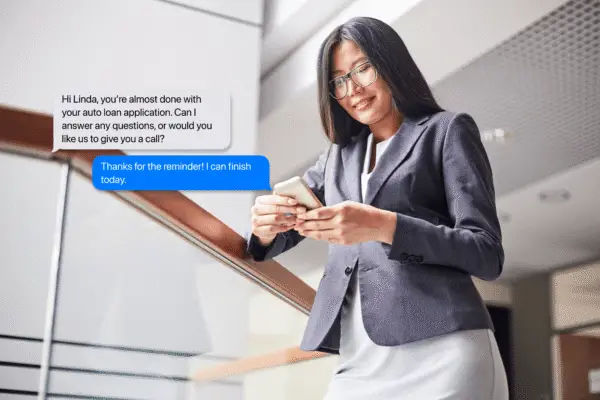
The platform addresses one of the biggest challenges businesses face when implementing SMS: the ability to respond instantly when customers expect it. When a lead comes in at 9 PM on a Saturday, only the largest businesses have someone available to respond. For other businesses, Verse steps in, responding immediately via SMS to engage the prospect while their interest is highest. The system is also smart enough to know when email is the more appropriate medium and seamlessly make that transition.
Unlike AI chatbots, Verse is designed to rely on the humans behind the scenes. This means that if it doesn’t have an answer, it will transfer the conversation to a real human rather than giving false information. This keeps your brand’s quality and accuracy high across all communication channels, even as it dramatically improves the speed and availability of your communications.
Ready To Transform Your Communication Strategy?
As you’ve learned, SMS outperforms email for time-sensitive or high-priority communications. However, comparing SMS vs. email doesn’t mean it has to be one or the other. A winning strategy coordinates these two channels perfectly, delivering each only where it delivers maximum impact.
For too long, doing so effectively was only feasible for the largest businesses. Verse changes that. It makes a sophisticated omnichannel approach available to all businesses. If you’re looking to improve lead response times, reduce no-shows, re-engage dormant prospects, or simply ensure no opportunity slips through the cracks, Verse will do the heavy lifting for you. It uses both channels in tandem to promote higher lead response rates. Get a demo or try our interactive demos here.
Frequently Asked Questions About SMS vs. Email Marketing
Is SMS marketing more effective than email marketing?
SMS marketing is often more effective for time-sensitive communication. Text messages have open rates around 98%, while email open rates are typically below 50%. SMS messages are also read faster and generate quicker responses, making them ideal for urgent updates, appointment reminders, and limited-time promotions. However, email remains valuable for longer-form content, newsletters, and detailed information.
When should businesses use SMS instead of email?
SMS works best for urgent, short, or action-oriented communication. Common use cases include appointment reminders, delivery notifications, limited-time offers, quick surveys, and customer service conversations. Because texts are read almost immediately, they are ideal when businesses need fast engagement.
When is email a better choice than SMS?
Email is better suited for longer or more complex communication. Businesses often use email for newsletters, product announcements with images, detailed receipts, onboarding information, and documentation customers may want to reference later. Email also allows for richer formatting and visual storytelling.
Why do SMS messages have higher engagement rates?
SMS messages appear directly in a person’s phone notifications, which people tend to check immediately. In contrast, email inboxes are often overloaded with messages and filtered by spam detection systems. Because texting is simple, direct, and mobile-first, it naturally encourages faster engagement.
Can businesses use SMS and email together in a marketing strategy?
Yes. The most effective communication strategies combine SMS and email rather than choosing one over the other. For example, a business might send a detailed product announcement via email and follow up with an SMS reminder when the product launches or a promotion begins. Using both channels strategically helps maximize reach and engagement.
Do customers need to opt in to receive SMS messages?
Yes. Businesses must obtain explicit consent before sending marketing text messages. Since SMS is a highly personal communication channel, maintaining transparency about what subscribers will receive—and how often—helps build trust and maintain high engagement rates.
How can businesses manage SMS conversations at scale?
Managing SMS at scale can be challenging because customers expect quick responses. Platforms like Verse help businesses automate and manage conversations across SMS, phone, and email, ensuring that leads receive immediate responses while still allowing human agents to step in when needed.