



It’s undisputed that SMS is the highest-read and responded to channel when it comes to getting in touch with your customers. A commonly-cited statistic is that 98% of texts are read.
But what do real-world SMS response rates actually look like?
In this year’s Texting Insights Report, we analyzed over 10 million text conversations handled by Verse to answer this question and more.
This article will break down the findings of the report to better understand how texting works in real-world applications, and if the response rates really are that good compared to other channels (spoiler alert: they are).
We’ll talk about:
- Channel performance
- SMS response rates
- Best times to text leads
- SMS for qualification
- How to improve SMS response rates
Defining SMS response rates
Text opens are not the same as replies; a text can be read but not responded to. The widely-cited figure of 98% texts being opened shows that SMS is great for getting your message read. But what about engagement?
SMS response rates are the rate at which text messages (or SMS) are replied to by the recipient. This metric measures real engagement.
Email vs. Phone call vs. SMS response rates
Verse research found that texts are not only opened, they’re replied to much more often than calls or emails.
Our analysis of over 10 million lead interactions showed:
- 50% average SMS reply rate
- 25% average call-only answer rate
- 1.4% average email reply rate
- 92% average answer rate when texting and calling
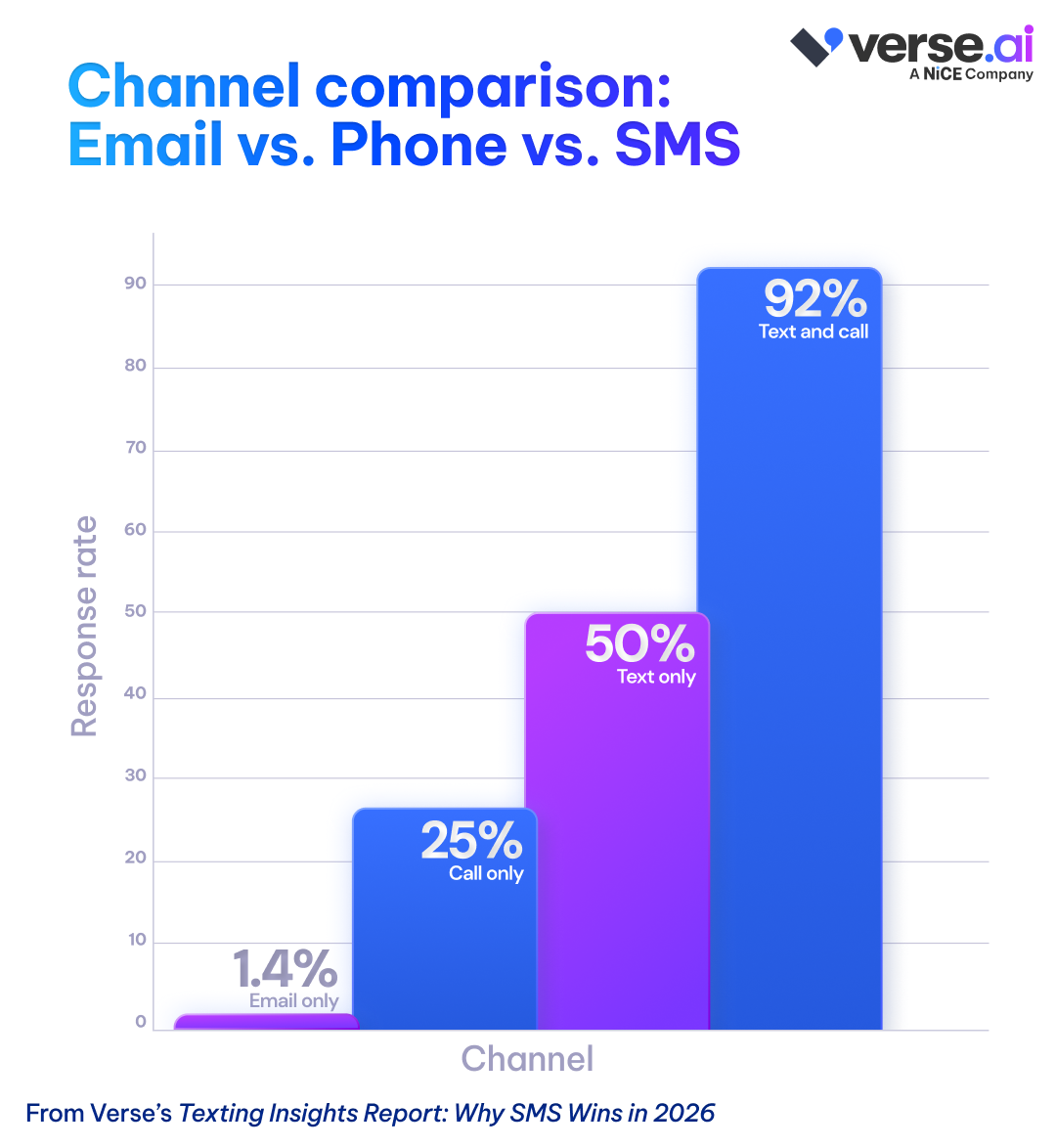
Unsurprisingly, email-only campaigns performed much more poorly than text and call campaigns. While benchmark email opens hover around 20%, reply rates are drastically lower at 1.4%. Since we do provide these leads with the ability to text rather than email us back, this likely drives that low number even lower.
Texting stands out as the channel with the highest response rate. In addition, we found that text-first strategies significantly improve call answer rates. When we used texting and calling as opposed to calling only, we saw a 3.68x higher answer rate.
Texting and calling is a winning combination because it allows the lead to engage on their time until they are ready for a call. When businesses text first, they show a respect for customer preferences and build upon the relationship before asking the prospect to hop on a call. When leads are nurtured and qualified over text, they are dramatically more likely to actually pick up the phone. And the data shows it.
Key takeaway: With an average 50% response rate, SMS is the highest-performing channel compared to email and phone. Combining SMS with phone leads to answer rates of 92%, so establish a relationship via text before you call.
Channel comparison: Email vs. Phone vs. SMS
| Factor | Phone | SMS | |
| Response rates | 1.4% | 25% | 50% |
| Effort | Low | High | Low |
| Speed of engagement | Often delayed or ignored | Requires real-time, uninterrupted availability | Instant delivery and quick replies |
| Interruptiveness | Low, but easily buried | High: requires immediate pick up | Low: asynchronous |
| Works after hours? | Yes | No | Yes |
| Scalability | Highly scalable | Labor-intensive | Highly scalable |
| Customer preference fit | Aligned, but increasingly ignored due to crowded inboxes | Misaligned; increasingly screened | Highly aligned with modern consumer expectation and behavior |
What is a good SMS response rate benchmark?
Generally, a “good” SMS response rate falls around 35-50%. According to Business.com, the average response rate for SMS marketing is 45%.
But, SMS response rates depend on your industry, use case, and campaign goals. For example, SMS performance metrics for marketing agencies show response rates of about 25%–35% depending on audience and message type.
Our study of Verse SMS conversations showed an average 50% SMS reply rate, which is at the high end of industry benchmarks. This means that conversational text engagement, especially when handled by experts like Verse, can exceed averages.
Overall, SMS response rates are significantly higher than email and cold calls. For comparison, email reply rates average 1-6% and cold call answer rates average around 10-13%.
In contrast to email’s low response rates and slower engagement times, SMS is ideal for real-time, two-way conversations with leads and customers.
SMS response rate benchmark range
SMS response rate is a strong indicator for audience engagement. Here’s a good rule of thumb when it comes to SMS response rates:
- Below 30%: Your messages might need better targeting, timing, or value.
- 30%–50%: Solid performance that aligns with many industry averages.
- 50%+: Excellent engagement that exceeds industry averages.
When do SMS responses come in?
In our Texting Insights Report, we also studied SMS response rates by time of day.
We found that the majority of SMS responses occur between 9am–4pm, with replies more concentrated in the morning (before noon).
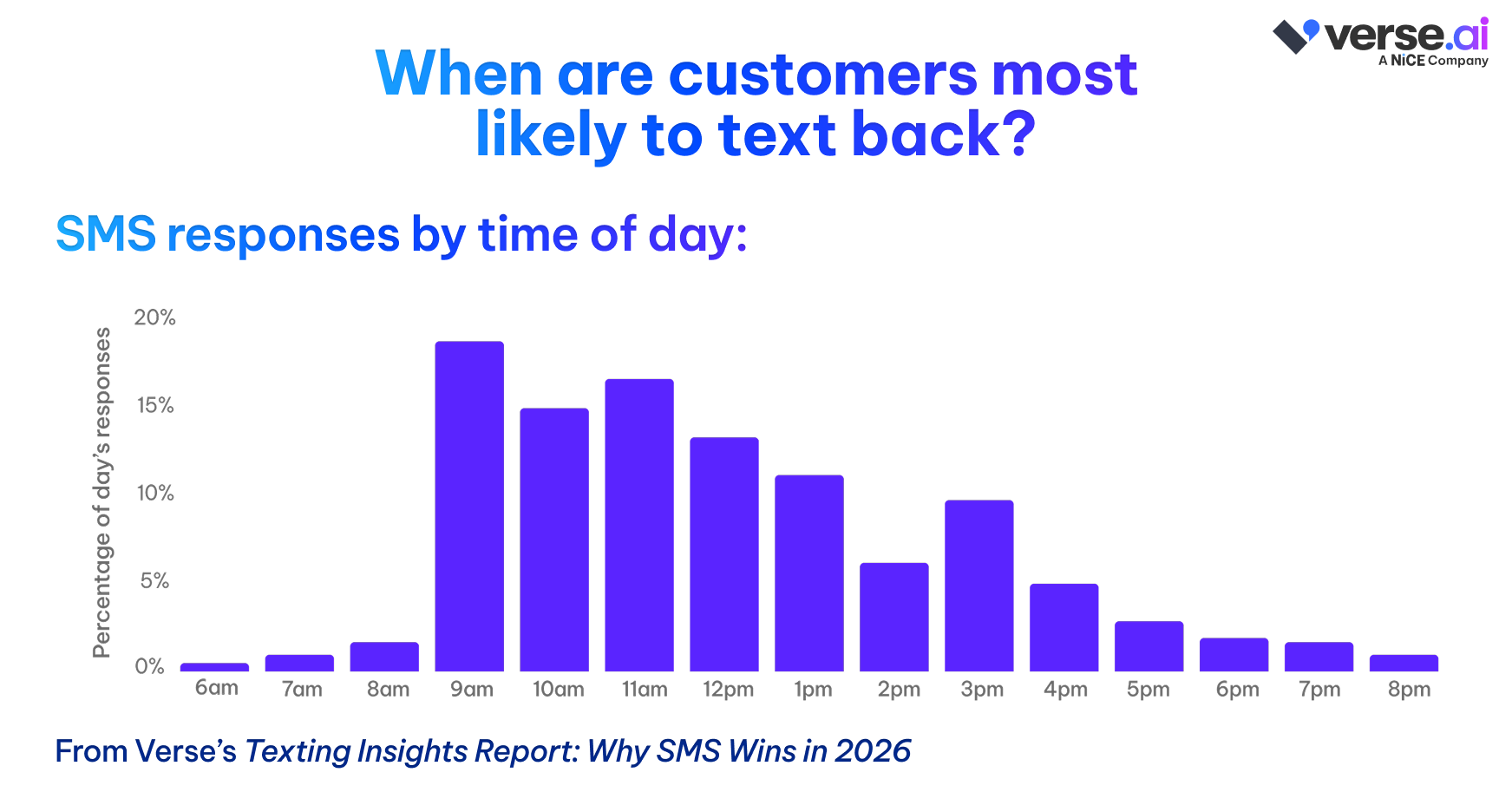
Though people are busy throughout the day with work, school, or family responsibilities, SMS fits right into workday behavior. It’s a quick, asynchronous, and convenient way to communicate, even while busy.
Key takeaway: people are ready to text throughout the day, especially in the morning from 9am-11am. Sales teams should be ready to engage with prospects during this time, providing speedy replies during peak hours.
SMS response rates for lead qualification
Our Texting Insights Report also found that many people prefer to answer qualifying questions via text. Qualifying questions see SMS response rates as high as 92%.
Qualifying leads via text makes the process faster, smoother, and more scalable for both your team and your prospects.
Some interesting data from Verse’s Texting Insights Report:
- Qualifying questions see reply rates up to 92%.
- It takes an average of 14 texts to qualify.
- Leads take an average of 270 minutes (4.5 hours) to qualify.
- Leads take an average of 223 minutes (~4 hours) to disqualify.
- Leads are most likely to qualify on Sundays.
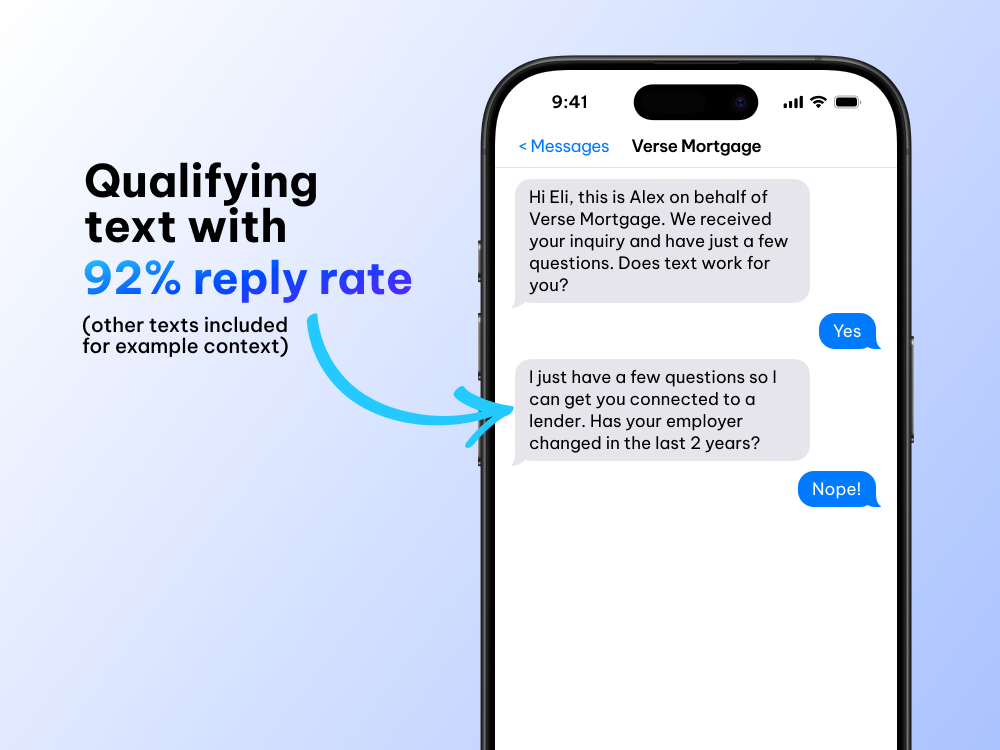
At 4.5 hours to qualify a lead, SMS lead qualification does require diligence and resources from your sales team. However, solutions like Verse help you scale SMS with automatic lead qualification, so your sales team simply receives qualified leads who are ready to talk.
Key takeaway: Prospects are ready and willing to answer qualifying questions via SMS. Qualifying via text can help with lead drop-off and ghosting.
How to improve SMS response rates
Interested in getting your SMS response rates higher? Here are six best practices that will help you boost SMS response rates.
Improve speed to lead
Speed to lead is how long it takes your business to respond to an inbound inquiry—and it’s an often overlooked metric. If you want more replies, make sure you’re replying in 5 minutes or less (ideally, 60 seconds or less). Data shows that leads are 21x more likely to convert if contacted within 5 minutes, and when teams respond within one minute, they see 391% higher conversions.
Only text those opted in
The number one rule for texting is to text compliantly. This includes proper opt-ins: express prior consent from the recipients of your text messages. Never text people who haven’t opted-in—they probably won’t reply, and worse, could report your business for texting without consent. For tips on compliantly building your subscriber list, check out this blog.
Follow up
Life happens: people get busy and don’t always reply. The problem arises when your business neglects to follow up with them. Follow-up texts are a huge part of increasing your overall SMS reply rate, because they get conversations going again.
Don’t inundate recipients with texts, but if the conversation goes unanswered, a nudge after a few hours, one day, or one week can be what brings the customer back.
Text at the right time
Just like with speed to lead, texting at the right time is important to maximize your probability of getting a reply. If your customer submits an inquiry at 6pm, you should text back instantly. But if you’re following up or reaching out via text for the first time, try texting during peak hours: 9am-11am. Be sure to keep in mind the recipient’s time zone.
Optimize messaging
If your texts are being read but not responded to, it’s probably time to check your messaging. Here are a few tips:
- Keep messages under 320 characters for a brief, straight-to-the-point message that sends in one SMS to most devices.
- Clearly identify yourself and your business.
- Make sure it’s clear that the recipient can reply to the message. Ask questions directly.
- Personalize the message as much as possible, referencing the recipient’s name, any information you have about them, and any prior interactions you’ve had.
- Make it clear why you are texting and what you want the recipient to do. For example, click a link to your website, buy a product on discount, schedule an appointment, etc.
- Limit emojis as too many can flag spam filters and make it so your message isn’t delivered.
- Preview messaging on different phones to ensure it appears as it should.
Test messaging
If there are no glaring mistakes in your message, the best way to improve messaging and reply rates is to test different messages and see what works best. Use A/B testing and try different messaging. Get creative, whether that’s changing phrasing, splitting things up into two texts, starting with the recipient’s name, or sprinkling in an emoji.
Increase SMS response rates with Verse
At Verse, we’ve found that texting is the best channel to connect with leads and customers. But, SMS with excellent speed to replies can be a heavy lift—which is why we fully-manage SMS conversations for our clients.
With conversational AI backed by our team of human concierges, Verse powers authentic SMS conversations at any scale.
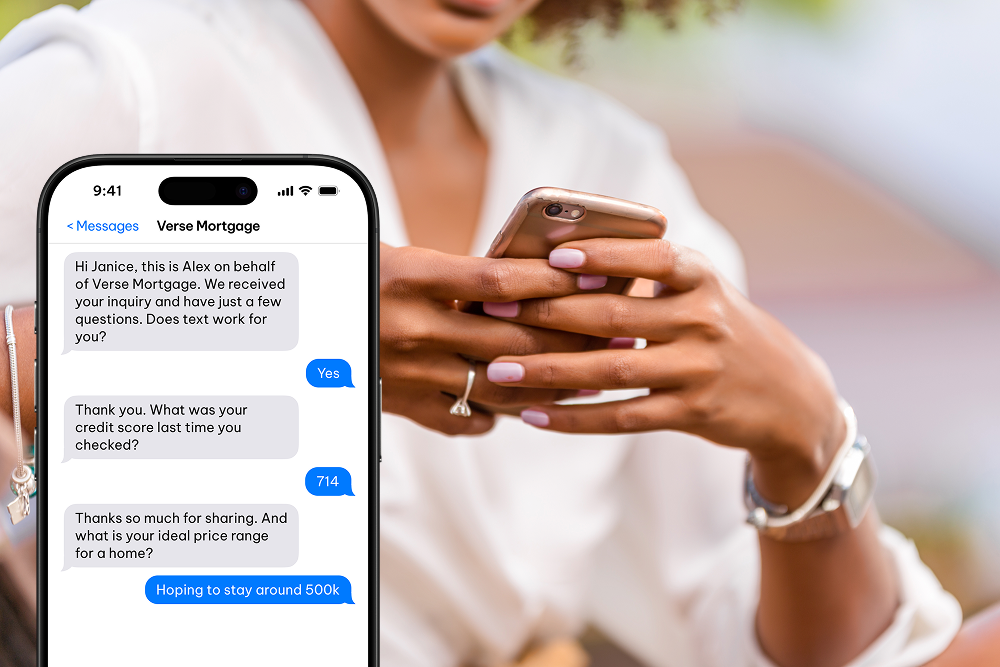
We reply instantly, 24/7, and pass responsive opportunities to your team. Using our live transfer function, we enable seamless transition from text to call when the lead is ready.
Ready to increase reply rates effortlessly? Learn more about Verse today.
Key takeaways: What the data says about SMS response rates