

7 Best Practices for Successful SMS Lead Nurture Campaigns
Most leads don’t convert on the first touch. In fact, 63% of prospects who request information today will not buy for at least three months, and around 80% of new leads never result in a sale without some form of nurturing in place.
If your conversion rates aren’t where you want them to be, it’s likely not a problem with your leads—it’s how you’re following up.
The good news is, there’s a channel that cuts through the noise, gets read almost immediately, and feels personalized and low-pressure. SMS lead nurture is quickly becoming one of the most effective tools for marketers to convert more leads into customers.
If you’re already running lead nurture campaigns, this guide will show you why adding text messaging to your mix is a huge opportunity for growth.
And the window to get ahead of it is still open: only about 14% of marketers currently use mobile automation in their lead nurturing programs.
Despite consumers checking texts so often, the vast majority of businesses are still leaving SMS entirely out of their nurture strategy. The brands that build this capability now will be significantly harder to compete with in 12 months.
What are lead nurture campaigns?
Lead nurture campaigns are automated, multi-touch sequences designed to build relationships with prospects who aren’t yet ready to buy. Rather than pushing for an immediate conversion, nurture campaigns educate, warm up, and stay top-of-mind with leads until they’re ready to take the next step.
Lead nurture focuses on meeting prospects where they are in the buying journey and decision-making process.
Lead nurture campaigns typically include:
- A sequence of messages triggered by user behavior or timing
- Personalized content based on lead interests or current stage in the funnel
- Educational and value-driven touchpoint
The value of lead nurturing is backed by strong data. According to Forrester, companies that excel at lead nurturing generate 50% more sales-ready leads at a 33% lower cost. At the same time, nurtured leads tend to make 47% larger purchases than non-nurtured leads.

Benefits of using text for lead nurture
Traditionally, lead nurture has been done through email, but SMS lead nurture is quickly growing in popularity. Texting allows brands to reach leads instantly on a highly-preferred, more direct and effective channel, making messages more likely to be seen and acted on.
SMS works alongside email, and for many audiences, it’s the better primary channel.
- SMS messages are opened at a rate of 98%, compared to email’s 20–32% average.
- Recipients typically read SMS within 90 seconds of receiving it, versus roughly 90 minutes for email.
- Verse’s analysis of over 10 million lead interactions found an average 50% SMS reply rate, compared to just 1.4% for email.
- Texting is the top mobile activity for 83% of consumers, outpacing social media and email.
- SMS opt-out rates average below 3%, compared to nearly 50% of emails that are filtered as spam.
For nurture campaigns where staying present is everything, SMS gives brands a meaningful edge.
How SMS for lead nurture works
Use cases
SMS lead nurture fits naturally into several common marketing and sales workflows:
- Re-engagement campaigns: reach back out to leads who went cold with a short, personalized re-engagement message that opens the door again.
- Content delivery: share a relevant resource (for example, a guide, blog, or video) based on a lead’s behavior or stage in the funnel.
- Appointment reminders and confirmations: reduce no-shows and keep booked leads engaged with friendly pre-appointment check-ins.
- Post-event follow-up: text leads who attended a webinar or event with a relevant resource on a similar topic.
- Long-term drip sequences: maintain low-pressure, periodic touchpoints with leads who are in research mode and not yet ready to buy.
SMS automation
Like email, SMS lead nurture scales with automation. Rather than your team manually texting every prospect, an automated platform can trigger messages based on lead behavior. This could be a form fill, a link click, a tag in your CRM, or a set time delay in a nurture sequence.
Automation allows you to:
- Respond instantly, 24/7
- Run personalized sequences without manual effort
- Route engaged leads to human agents at the right moment
- Keep all conversation history synced back to your CRM in real time
The best SMS nurture programs blend automation with human touchpoints, using AI to handle the initial engagement and cadence, while making it easy for a real person to step in when the lead is qualified and ready.

Common mistakes in SMS lead nurture strategies
Even marketers who recognize the opportunity often underperform with SMS because of avoidable execution errors. Here are a few examples of mistakes to avoid.
Using one-way SMS only
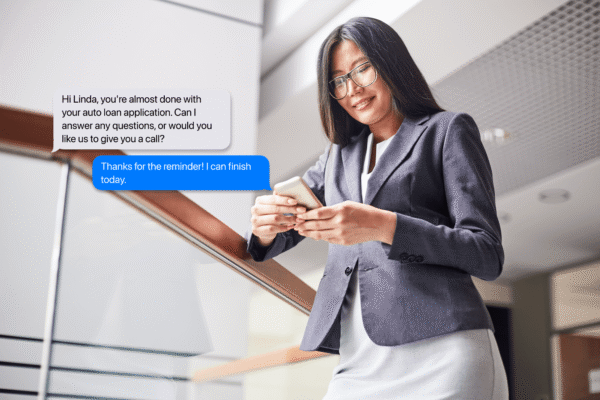
Blast-style texting, where you send a message and don’t invite or handle replies, misses a key piece of what makes texting so great: the conversational element. When a lead replies and gets silence (or a “do not reply to this number” bounce), that creates frustration instead of warm engagement.
Effective SMS nurture is a two-way channel where leads can express interest and get a real, timely response.
For example:
- One way:”We wanted to share this week’s home loan rates. Visit [link] for more info. Reply STOP to unsubscribe.”
- Two way: “Hi Mark! Rates shifted this week and it might affect what you’re looking at. Want me to send over a quick breakdown? Just reply yes and I’ll get that to you.”
Message frequency
Cadence can be a tricky thing to get right in lead nurture. Texting a lead every day can drive opt-outs fast, but waiting three weeks between touches in an active nurture sequence lets momentum die.
The specifics will vary by industry, audience, and funnel stage. However, the goal is the same: stay present, but don’t be overwhelming or annoying. Cadence should also adapt to lead behavior. If someone just replied or clicked a link, the time to follow up is now, not two weeks from now.
A successful lead nurture sequence might look like this:
- Day 1: Initial follow-up text immediately after form fill
- Day 2–3: A second touch with a relevant resource or question
- Day 7: A mid-week check-in if no response
- Day 14: A re-engagement message with a special offer
- Monthly: Helpful, timely resources for longer-term leads
Generic messaging
People want to be remembered and valued, and they can tell when a message has nothing to do with who they are or where they are in their journey.
Personalization doesn’t have to be complex. Even referencing the lead source, the service they expressed interest in, or their company name makes a message more relevant.
For example:
- “Hi there! This is ABC Solar. Interested in your options? Check out our website to learn more.”
- “Hey Jamie, this is Alex with ABC Solar. I see you checked your solar savings calculator last week. Based on your zip code, you could qualify for a pretty significant rebate. Want me to send over the details?”
The first message could have been sent to anyone. The second one feels like it was written for Jamie specifically—even if it was automated.
Jumping straight to a call/appointment
SMS drives revenue, but it’s not a shortcut. SMS lead nurture should encourage the recipient to take action, but not before they’re ready.
Nurture means warming up first: giving leads a reason to engage before you ask for additional investment on their part.
- “Hi! I’d love to set up a 30-minute call this week to walk you through our platform. Are you free Tuesday at 2pm?”
- “Hi John, this is Alex with ABC Mortgage. I see that you downloaded a resource on saving for your first home. Would you like to talk more about your goals and budget?”
The first message is asking for a commitment before earning one. The second starts a dialogue that can naturally lead toward a call once the lead is ready.
Weak CTAs
Every message should encourage action with a clear and appropriate call-to-action (CTA).
Good CTAs are specific, low-pressure, and appropriate to the lead’s stage: a link to a relevant resource, a simple yes/no question, or an invitation to reply with more information.
- “Hi Jana, this is Alex from ABC Homes checking in with you.”
- “Hi Jana, this is Alex from ABC Homes. We put together a short guide on buying your first home. Want me to send it over?”
The second message has an obvious call to action and invites a quick reply, increasing the chances of getting a response.
Overly manual processes
When texting falls to individual reps, execution becomes inconsistent. Some leads get followed up with immediately; others fall through the cracks on a busy day.
If your SMS strategy depends entirely on human effort, it won’t scale or perform consistently.
Consider the difference between these two scenarios:
Manual process: A new lead fills out a form at 9pm on a Friday. A rep sees it Monday morning and sends a text. By then, the lead has already moved on (or worse, heard from a competitor.)
Automated process: The same lead gets a personalized text within 60 seconds of submitting the form. If they respond, they’re automatically qualified and sent to a human rep. If not, a follow-up sequence kicks off automatically.
7 best practices for SMS lead nurturing
Opt-ins and compliance
More than anything else, you need explicit consent to text your leads. This is not optional. Compliance refers to legal requirements under regulations like the TCPA, and non-compliance carries significant financial penalties and loss of trust from your audience.
Make sure your opt-ins and opt-outs are compliant, your records are documented, and you’re using the right language. For a full breakdown of what you need to have in place, see our SMS compliance checklist.
Segment and personalize messaging
Segmenting your audience based on lead source, behavior, industry, stage in the funnel, or prior engagement lets you send messages that feel personal.
Common segmentation variables for SMS lead nurture include:
- How the lead came in (website, social media, comparison website, etc.)
- What page or content they interacted with
- Where they are in the funnel
- Whether they’ve engaged with previous messages
- Industry or company size (for B2B)

Conversational tone
The best-performing SMS nurture messages read like they came from a human. Keep your language natural, warm, and direct. Use the lead’s first name. Avoid jargon. Write the way you’d actually text someone.
Compare these two approaches:
- “Hi Sarah, this is Alex with ABC Software. We wanted to reach out regarding our outcome-driven solutions.”
- “Hey Sarah, this is Alex with ABC Software. I saw you checked out our guide on boosting CSAT and I think we can help. Are you free to chat?”
Time messages correctly
Sending at the right time dramatically affects whether your message gets a response. In our analysis of 10 million lead interactions, we found that the majority of SMS responses occur between 9am–4pm, with the most replies coming in from 9am-11am.
But the real answer is: test with your specific audience and let the data tell you.
Keep it short
SMS is a short-form channel. If you have a long message, save it for an email. Under 320 characters tends to perform best.
Here are two follow-up texts—the first reads like an email, while the second is a better text message. In our research, the second boosted replies by over 9x.
- “Hello Amy! I hope you’re doing well. Just a friendly reminder that we’re able to address any queries or provide further information you may need.”
- “Hi Amy, it’s Alex. Let me know. :)”
Track and optimize
SMS lead nurture is not set-and-forget. Track and review key performance indicators (KPIs) to understand what’s working and what isn’t.
The metrics that matter most include:
- Response rate: are leads engaging with your messages?
- Qualification rate: are responses moving leads forward in the funnel?
- Re-engagement rate: how many cold leads are being reactivated?
- Conversion rate: how many leads from SMS sequences are eventually converting?
- Time-of-day performance: when are your messages getting the most engagement?
- Individual message performance: which messages in your sequence are getting responses, and which are leading to opt-outs?
Complement other channels
SMS is most powerful as part of a multi-channel strategy, not a replacement for everything else.
Combining SMS and email can increase overall engagement by up to 35% — and adding a third channel like voicemail can push that further. Showing up in more than one place means more chances to break through.
Email remains the backbone of most lead nurture programs. It’s still the channel most marketers have the deepest infrastructure for, and it’s well-suited for longer-form content: detailed guides, case studies, comparison pages, or multi-section nurture sequences that need room to breathe.
SMS shouldn’t do the same things that email does. Where SMS excels at getting an immediate, conversational response, email excels at depth and context. A lead who doesn’t respond to a text might engage with a well-timed email with a relevant piece of content; a lead who’s been passively opening your emails might finally reply to a short, personalized text that cuts through.
Voicemail is a channel most people don’t associate with nurturing, but voicemails can help authenticate your message while remaining respectful and non-intrusive. A voicemail drop is a pre-recorded message delivered directly to a lead’s voicemail inbox, without their phone ringing.

Use SMS for lead nurture with Verse
Verse is a fully-managed, AI-powered conversational platform that handles the entire nurture workflow, across SMS, email, and phone, so your team doesn’t have to.
Our platform combines AI with a team of human agents to engage new leads instantly, qualify them through natural two-way conversations, and book appointments with prospects who are ready to move forward. All of this happens automatically, 24/7, across SMS, phone, and email.
Verse includes:
- Conversational AI + human agents for quality assurance
- Built-in compliance and expert script design
- CRM integration with full visibility into conversations
- Fast setup and professional services
Learn more about Verse by booking a call today, or viewing our self-serve demos here.
Key takeaways: SMS lead nurture