


Healthcare communication has a timing problem. Patients have questions after business hours, appointment changes happen at the last minute, and routine outreach can quickly turn into phone tag. Meanwhile, staff members are balancing scheduling, care coordination, intake, and patient support.
AI-powered SMS for healthcare gives healthcare organizations another way to stay responsive without asking staff to manage every text manually. Instead of using standard SMS only for one-way alerts, conversational AI can support two-way texting, understand what a patient needs, respond within an approved workflow, and route the conversation to a person when human judgment is needed.
For healthcare providers, that can make text messaging a more useful communication channel for patient engagement: appointment reminders, scheduling, FAQs, follow-up, and other routine patient communication.
What is AI-powered healthcare SMS?
Healthcare SMS uses text messages to communicate with patients and prospective patients. AI-powered healthcare SMS adds conversational intelligence and automation, so patients can reply naturally rather than receiving a message that ends the interaction.
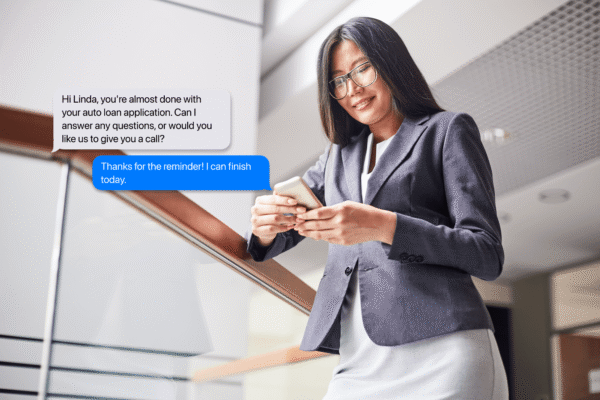
For example, an appointment reminder might ask a patient to confirm or reschedule. If the patient replies, “I can’t make Tuesday. Do you have anything Thursday afternoon?”, an AI agent can identify the intent, follow an approved workflow, and help find another time. With the right integrations, it can also update the connected scheduling or CRM system.
That is the difference between a basic text blast and conversational AI texting: the message can become a conversation. Verse’s healthcare AI agents support conversations across text, chat, email, and phone, including appointment scheduling and rescheduling.
 How AI-powered SMS works for healthcare organizations
A well-designed SMS solution typically follows a simple flow:
- A patient opts in. The organization captures appropriate patient consent and communication preferences. For promotional messages or SMS marketing, teams should evaluate whether express written consent is required and maintain records of opt ins and opt out requests.
- A workflow triggers a message. That could be a new-patient inquiry, an upcoming visit, a missed appointment, a prescription refill reminder, or another approved event.
- The AI interprets the reply. Patients reply in their own words, and conversational AI identifies intent. The system can use pre-approved templates, knowledge, and business rules instead of forcing every interaction into a rigid menu.
- The system takes the next approved action. It may send appointment reminders, share appointment details, answer a routine scheduling question, help reschedule appointments, or hand the conversation to a staff member.
- The interaction is recorded. Integrations can keep patient conversations and workflow outcomes visible in the systems teams already use, helping reduce duplicate work and improve operational efficiency. Verse supports CRM and software integrations alongside appointment-setting workflows.
The result is targeted messaging that feels more responsive than a one-way campaign and more convenient than waiting on phone calls during business hours.
Where AI-powered patient texting can help
Scheduling is a natural use case. Automated appointment reminders can help reduce no shows while giving patients a simple way to confirm, cancel, or choose another time. When a patient leaves a scheduling conversation unfinished, an AI agent can follow up according to the organization’s rules instead of letting the request sit unread in a queue.
The same model can support other routine healthcare communication. Depending on the organization, approved workflows might notify patients about facility updates, flu shots, new services, prescription refills, care plans, or general health tips. Home health organizations may use targeted messaging to reinforce visit logistics or treatment plan follow-up. For urgent updates or critical information, healthcare providers should use escalation paths appropriate to the situation rather than rely on SMS alone.
AI-powered texting can also help new patients move from inquiry to appointment faster. Rather than waiting for a callback, a prospective patient can ask a question, provide basic information, and schedule a visit from a smartphone. That can reduce phone tag and free staff to spend more time on patient care.
 What about HIPAA compliance, PHI, and patient consent?
This is where healthcare texting requires extra care. Protected health information, or PHI, can be involved in patient texts, and healthcare organizations need to evaluate how patient data is created, received, maintained, and transmitted across their technology stack.
If a technology vendor is acting as a business associate and handles electronic protected health information on behalf of a covered entity, HHS guidance says the parties generally need an appropriate business associate agreement, or BAA, and must meet applicable HIPAA requirements. The business associate agreement defines permitted uses and disclosures and requires appropriate safeguards for PHI.
That is why teams should not assume that any texting tool is automatically a HIPAA compliant platform simply because it sends SMS messages. When evaluating secure messaging platforms, ask how the solution handles access controls, audit trails, data retention, encryption, authentication, and lost devices. If staff access patient data on a personal phone, device-management controls such as remote wipe capabilities may also be part of the organization’s broader security strategy.
Sensitive information deserves channel-specific judgment. A standard SMS notification might tell a patient that new test results are available, while the actual results may be better delivered through patient portals or another approved secure workflow. HHS advises covered entities and business associates to perform risk analysis and apply appropriate safeguards to electronic PHI.
Consent matters beyond HIPAA, too. The TCPA regulates certain calls and texts, and FCC rules address consent and revocation. Healthcare organizations should build clear consent forms, document communication preferences, honor opt-out requests, and work with qualified counsel on promotional messages and SMS campaigns. Current FCC rules continue to define prior express written consent for certain advertising or telemarketing communications, while consumers retain rights to revoke consent.
Verse’s trustContact™ compliance suite supports business texting with tools and guidance around opt-ins, opt-outs, A2P registration, deliverability, and related requirements. Verse’s healthcare page currently states that the platform maintains SOC 2 compliance, TCPA-compliant messaging, and strong data-protection standards.
How AI-powered SMS can improve the patient experience
The value of healthcare texts is not simply speed. It is making routine interactions easier to complete. For most patients, convenience can mean confirming an appointment, asking a scheduling question, or responding when they have time instead of waiting on hold.
When patients can confirm an appointment, address concerns, or request a new time by text, they have a direct path to action. When routine patient needs are handled automatically and more complex questions are escalated, staff can focus attention where it matters most.
That can support patient satisfaction and a more proactive approach to communication. It can also help close common gaps around missed appointments and incomplete follow-up. In some programs, timely messaging may support goals such as medication adherence, care-plan participation, health outcomes, and reducing avoidable hospital readmissions—but those outcomes depend on the clinical program, patient population, and how messaging is designed.
AI should not replace clinical judgment, change a treatment plan, or become a source of medical advice. Its best role is to make routine communication easier to scale while preserving a clear path to human support.
Choosing an AI SMS solution for healthcare
Healthcare providers should look beyond message volume and ask how a platform fits the patient journey. Can it support two way texting? Can patients move from a text to a scheduled appointment or live conversation? Does it integrate with existing systems? Can teams define approved workflows and escalation rules? Are compliance controls and conversation records visible?
Verse combines AI-powered texting, appointment setting, integrations, and human oversight to help organizations manage responsive conversations at scale. Its healthcare solution is designed to help providers engage patients 24/7, schedule and reschedule appointments, send reminders, and route conversations across channels.
For healthcare organizations, the goal is not to send more messages. It is to make each message more useful, giving patients a convenient next step while helping teams operate more efficiently.
Ready to see how AI-powered SMS could fit your patient communication strategy? Book a demo with Verse.