

For a multi-location business, even one slow-responding location costs the brand both customers and brand credibility. And right now, most franchise and multi-location brands are fighting a lead response problem.
A 2025 mystery-shopping study found that 66% of franchise businesses didn’t even answer the phone when a prospective customer called (Franchise Business Review). With texting, specifically, the channel customers increasingly prefer, a separate audit of 500+ franchise brands across 14 categories found that 73% never used SMS to follow up with a lead at all, 35% never responded to an inquiry through any channel, and the average email response time was 8.8 hours.
The cost of slow lead response is well documented. Leads contacted within five minutes are 21x more likely to convert than leads contacted later, and waiting even 30 minutes instead of 5 minutes makes a lead 100x less likely to qualify.
Yet most companies, franchise or otherwise, aren’t close to that bar: studies show 57% take a week to respond to inquiries, and 51% of leads are never contacted at all.
For a multi-location or franchise system, this pattern plays out location by location, which means the brand’s actual response time can vary widely, and ultimately, is only as strong as its weakest location. This article will explain the problem with franchise lead management, importance of speed to lead, and how to standardize lead response to drive greater outcomes at scale.
Common problems with franchise lead management and response
Leaving lead response up to whatever each location’s sales team happens to do is a bad bet, and it shows up in a few predictable ways:
- Response times vary by location. One location might reply in minutes; another sits on a lead for a day, a week, or forever. Without a standard, speed becomes a function of which individual happened to pick up the lead.
- Messaging isn’t consistent. Even when a location does respond, what they say (for example, how they qualify the lead, what they emphasize, how “on-brand” the conversation feels) can vary between locations and even between reps at the same location.
- Follow-up drops off. If there’s no standardized process to catch and re-engage a lead that’s gone quiet, a lead that doesn’t respond to the first message often just doesn’t get a second one.
Each of these costs real deals and real money, and they compound: a corporate marketing budget spent generating a lead is wasted the moment that lead reaches a location that’s slow, inconsistent, or simply doesn’t follow up.
This is precisely why consistency matters as much as speed. PwC’s Trust in US Business Survey found that consumers rank delivering a consistent, reliable customer experience as one of the top factors in earning their trust—nearly as important as protecting their data. For a franchise brand, consistency can be a challenge when juggling multiple locations, but this is exactly what standardized lead response is designed to fix.
 What is a good lead response time?
The short answer is under 5 minutes. That’s the benchmark that separates businesses that convert leads from businesses that lose them, and it’s backed by a large body of research on speed to lead: the amount of time it takes a business to follow up with a new lead after they reach out.
- Leads contacted within 5 minutes are 21x more likely to convert than leads contacted later.
- Leads are 100x more likely to qualify when contacted within 5 minutes versus 30 minutes.
- Teams that respond within one minute see up to 391% higher conversions. (Sources can be found here)
The reasoning behind these numbers is straightforward: customer intent peaks the moment they reach out, and it decays fast. People don’t want to wait, and they don’t want to put in extra effort to make a purchase decision. They expect a business to meet them on their terms, immediately. 78% of customers buy from whichever business responds first, and over half of people will hire the first business to respond even if it costs more.
For franchises specifically, this creates a harder problem than it does for a single-location business: a customer doesn’t just compare you to competitors, they compare one of your locations to another. If a customer had a fast, easy experience with your brand in one city, they’ll expect the same in the next. If a different location can’t deliver that, the brand takes a hit.
Standardizing lead response
Standardized lead response means every single lead—regardless of which location, channel, or time of day they come in—gets a fast, consistent, and personalized follow-up. No lead waits. No lead is treated differently because of which location or rep happens to pick it up. Leads don’t slip through the cracks, and interest gets qualified before it cools off.
What does standardized lead response look like?
In practice, standardized lead response for franchises includes:
- Instant replies for every lead, ideally under 1 minute and never more than 5, regardless of the time of day or which location the lead belongs to.
- Consistent follow-up and re-engagement for leads that go quiet, so a lead that doesn’t respond to the first message doesn’t just disappear from the pipeline.
- Friendly, conversational messaging that qualifies leads naturally, while still sounding the same in tone and quality no matter which location the lead came from.
 SMS for Franchise Lead Response
Text messaging is one of the most underused levers available to franchise and multi-location businesses, and data backs it up. Recall the numbers mentioned earlier: 73% of franchise brands never use SMS to follow up with a lead at all, even though texting is consumers’ most-preferred communication channel, with open rates around 98%.
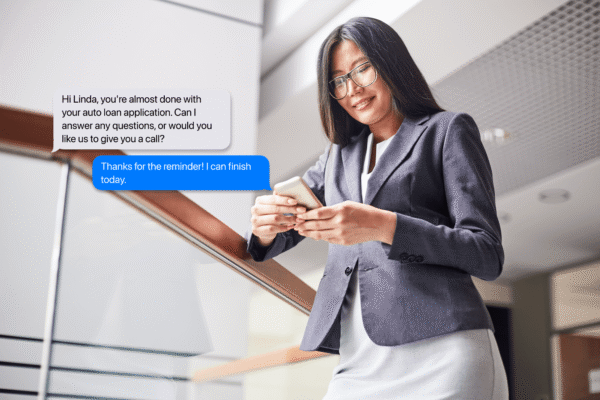
People treat texting differently than a call or email. A prospect who fills out a form on a Tuesday night isn’t sitting by the phone waiting for a call the next morning, but a text lands immediately, within the app on their smartphone that they’re already using, and can open a real conversation before a competitor ever reaches them.
For lead response, texting must be two-way and conversational. This is not the same as marketing SMS or one-way blasts. A text blast can remind someone about a promotion; it can’t answer their question, qualify their intent, or offer a time to talk. Real lead engagement over SMS means holding an actual back-and-forth conversation at the moment a lead comes in, at scale, across every location.
 Automating the top of funnel for multi-location businesses
If everything above sounds impossible for a busy human team to pull off consistently, that instinct is correct: it’s not realistic to expect people to respond instantly, 24/7, across every location, with zero inconsistency. That’s exactly why automated solutions (like Verse) exist to handle top-of-funnel engagement: qualifying leads the moment they come in, streamlining the customer experience, and creating the consistency a franchise brand needs.
This doesn’t mean replacing your people. It means giving them qualified leads and complex problems to focus on, instead of the repetitive first-response work that’s currently falling through the cracks.
How AI works to standardize lead response
If follow-up isn’t currently a priority (or isn’t being done well) adding AI can close that gap almost immediately. AI agents respond to every lead in seconds, 24/7, regardless of location, time zone, or staffing levels, asking qualifying questions and answering customer questions.
A few things make this work well in practice:
- Personalization at scale. Using available lead data, AI can tailor the conversation to the individual lead rather than sending the same generic message to everyone.
- Omnichannel support, including SMS. Solutions like Verse support texting for every lead, which matters given how much higher engagement rates are on SMS compared to email or one-way outreach.
- Live transfer to a human. When a conversation needs a person (for example, a complex question, a ready-to-buy lead, a sensitive situation) the AI hands off smoothly, with context.
AI adoption for this kind of top-of-funnel engagement is growing quickly, and franchise systems that standardize before it becomes the norm across the industry can get a real head start on brands that are still leaving lead responses up to whichever location happens to answer the phone.
AI agents for better franchise lead response
Standardize franchise lead response with Verse’s omnichannel AI agents. Our AI agents engage leads in two-way conversations spanning SMS and RCS, webchat, email, ringless voicemail, and phone—with replies under 15 seconds. Leads engage through whatever channel works for them, and receive consistent responses, 24/7.
With Verse, leads can move across channels, and transfer to human reps seamlessly, with analytics that give you full visibility into every interaction. The Verse platform is fully-managed and goes live in 30 days.
Ready to learn more? Book a demo with us today.