


A single missed appointment can run a medical practice roughly $200 in lost revenue. For a multi-provider practice seeing dozens of patients a day, that adds up fast—and it’s just one piece of a bigger administrative load. A study of 7,000 calls across 22 medical practices found that 42% of incoming calls during business hours go unanswered.
AI agents for healthcare can take on basic tasks and enhance patient communication. AI agents can help answer basic questions, schedule appointments, update patient records, and reduce patient wait times while freeing up human agents to help with complex questions.
At the same time, a study found that only 19% of healthcare practices are using AI for patient communication, making it a competitive advantage for medical teams. Patients don’t want to call and wait on hold anymore and increasingly show a preference for digital-first communication. 85% of U.S. adults use text messaging weekly, and it is the #1 channel across every generation and gender group (yes, even Baby Boomers).
For teams managing multiple providers, locations, or a high daily patient volume, these numbers point to the same conclusion: administrative capacity is now a bigger constraint on growth than demand is. AI agents give larger practices a way to scale patient communication without scaling headcount at the same rate, while still meeting the compliance, accuracy, and human-handoff standards that patient care requires.
What are AI agents for healthcare?
An AI agent for healthcare is a software system that uses natural language processing, generative AI, and workflow automation to hold real conversations with patients—over the phone, by text, or through webchat—and take action on their behalf.
Instead of routing a patient through a static phone tree or a scripted chatbot, an AI agent understands what the patient is asking, checks it against real scheduling and account data, and completes the task. For example, they conduct tasks like booking an appointment, answering an insurance question, sending a reminder, or collecting intake information before a visit.
Unlike a basic chatbot, an AI agent can act. They can pull up a provider’s real-time calendar, update the electronic health record (EHR), or trigger a follow-up message—all within a single conversation. That’s what makes AI agents relevant to healthcare specifically: the industry runs on scheduling, follow-ups, and repetitive administrative questions that eat into staff capacity, and AI agents can help.
SMS: A personal channel for healthcare conversations
Before getting into the benefits and requirements of AI agents, it’s worth pausing on why texting specifically deserves a place in a healthcare communication strategy.
Texting occupies a different psychological space than email or even phone calls. Research on interpersonal communication has found that text messaging plays a distinct role in building and maintaining closeness in relationships, functioning as a channel people associate with personal, ongoing connection rather than transactional exchange.
That association carries over into how people respond to texts from organizations, which is part of why texts consistently see open rates of 98%, compared to roughly 26% for email.
A study published in the National Library of Medicine found that 95% of patients report feeling more connected to their care team after receiving text updates.
For healthcare, that trust and immediacy translate directly into outcomes. Text messaging has been used effectively as a platform for supporting behavior change and psychological wellbeing precisely because it’s personal and low-friction enough to reach people who don’t engage with apps or portals.
Practically, this shows up in things like appointment reminders: a systematic review of 29 studies found automated appointment reminders cut non-attendance by a weighted average of 29%.
This is where AI agents have the biggest impact because they can scale real, two-way conversation over text: confirming an appointment, answering a follow-up question about prep instructions, or rescheduling on the spot, for thousands of patients at once, without a staff member manually managing each thread. AI agents let healthcare teams scale that personal, trusted channel into a real conversation.
 Key benefits of AI Agents for healthcare
For medical practices of all kinds—including urgent care centers, primary care practices, mental health providers, dental offices, and physical therapy providers—AI agents can benefit both patients and internal teams, improving patient outcomes and satisfaction at scale.
Enhance patient engagement
Patients don’t want to wait on hold to ask a simple question, and they increasingly expect to reach out over whichever channel is convenient for them.
AI agents respond instantly across chat, text, email, and phone, and carry context between them, so a patient who starts a conversation by text and follows up by phone doesn’t have to repeat themselves.
Even among older patients, this shift is well underway: 86% of Baby Boomers check their mobile notifications within 5 minutes. From Gen Z to Boomers, omnichannel accessibility benefits every patient.
Reduce call volume
A study of 7,000 calls across 22 medical practices found that 42% of incoming calls during business hours go unanswered. At the same time, roughly 80% of appointments are still scheduled by phone, meaning every missed call risks a missed appointment.
A PMC peer-reviewed study found that 91% of patients say that text messages help them avoid making unnecessary calls to their provider. AI for texting can help field questions and reduce inbound call volumes.
AI agents absorb call volume by handling scheduling, rescheduling, and common questions directly, without a staff member needing to pick up the phone.
Increase patient service speed
When AI handles repetitive, high-volume requests, human staff are left with the calls that actually need a person: complex clinical questions, sensitive conversations, and situations requiring judgment.
This isn’t about replacing staff; healthcare organizations that adopt AI agents can redeploy existing staff to higher-value work. The result is that patients with simple needs get answered faster, and patients with complex needs get a human who has more time and context to help.
Reduce no-shows
Patient no-shows cost the U.S. healthcare system an estimated $150 billion a year, and a single missed appointment can cost a practice roughly $200 in lost revenue.
A systematic review of 29 studies found automated appointment reminders cut non-attendance by a weighted average of 29%. Another peer-reviewed Cochrane review found attendance rising from 67.8% (no reminder) to 78.6% (text reminder), about an 11% increase.
With AI agents for appointment setting, larger gains come not just from sending reminders but from holding two-way conversations that confirm attendance, surface scheduling conflicts early, and offer rescheduling before a patient simply doesn’t show up.
Support operational efficiency
AI agents don’t just talk, they also connect to a practice’s EHR, scheduling system, or CRM to complete work. Integration is what allows an agent to check real-time provider availability, update patient records, and route information to the next system or team member automatically, rather than requiring staff to re-enter information the AI has already collected.
Things healthcare teams must look for in AI agent solutions
When evaluating AI solutions, healthcare providers have a specific set of criteria. Unlike other businesses, healthcare is extremely regulated and personal in every aspect, and any AI solution must measure up.
Compliance
Any AI agent handling patient conversations needs to meet compliance requirements for protected health information, and any agent that texts or calls patients needs to comply with TCPA rules around consent and communication frequency. Healthcare teams should confirm this isn’t an add-on feature but something built into the platform’s architecture from the ground up.
Strong data privacy
Patient conversations often include sensitive health, financial, and personal information. Healthcare teams should ask AI vendors directly where transcripts and call data are stored, how long they’re retained, whether patient data is ever used to train the underlying AI model, and how deletion requests are handled.
Controlled AI
An AI agent that sounds confident but gives a wrong answer about medication instructions, coverage, or appointment details is a huge risk. Teams should look for platforms that restrict the AI to approved knowledge sources and clinical information, use confidence thresholds to avoid guessing, and make it easy to see and control exactly what the AI is allowed to say.
Live transfer functionality
AI agents should not be the last stop for a sensitive or complex patient conversation. The platform needs a clear, well-defined path and ability to hand off to a human. Ideally, live transfer passes along the conversation history, patient intent, and any information already collected, so the patient doesn’t have to start over with the next person they talk to.
Scheduling and rescheduling functionality
Since scheduling represents such a large share of patient communication, an AI agent’s ability to check real-time availability, book, reschedule, and cancel appointments directly within the practice’s existing systems is a core use case. Healthcare teams should verify this works against their actual EHR or scheduling software.
Trusted AI agents for healthcare teams
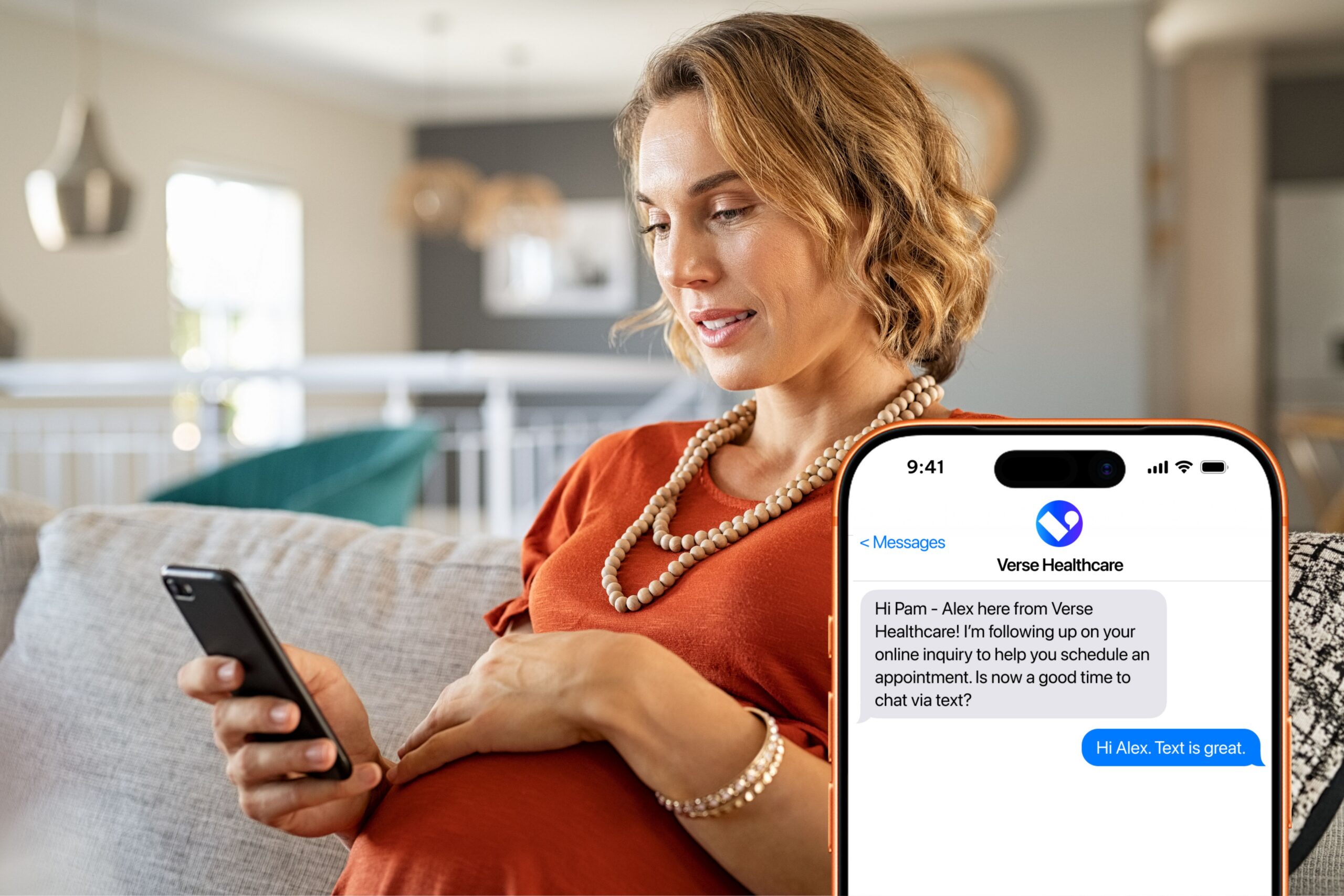
Confidently use AI agents with Verse. Verse’s AI agents for healthcare engage patients on every channel, and can schedule, reschedule, confirm, and cancel appointments over text, phone, or chat.
With Verse, healthcare providers:
- Allow 24/7 patient engagement and self-scheduling
- Engage and qualify patients across medical practices
- Schedule and reschedule appointments so healthcare professionals spend less time on administrative tasks and more time focused on patient outcomes.
- Reach more patients with promotions, automated appointment reminders, and confirmations.
Learn more by booking your Verse demo.
Key takeaways: AI agents for healthcare