



While 80% of loan applicants say text communication is important, 41% do not receive a single text during the application process, according to a Datos Insights survey of 1,506 consumers who applied for a personal loan, auto loan, or credit card in the past year.
For banks and credit unions, SMS marketing is a critical but underlooked part of a robust customer communication strategy.
SMS marketing for banks sends offers, follow-ups, and reminders in the channel customers check constantly.
This guide covers what it is, why it works, where it fits in the customer journey, how to stay compliant, and how to implement it.
What is SMS marketing for banks?
SMS marketing for banks is the use of text messages by banks, credit unions, and lenders to promote products, engage leads, and build relationships with people who have opted in. Typical messages include welcome texts, application follow-ups, appointment reminders, offers, and re-engagement prompts.
Many institutions already text for alerts and verification. Marketing and sales texting extends that habit to the full customer journey.
One-way vs. two-way SMS
Marketing SMS is traditionally one-way: think SMS blasts without a reply option.
However, two-way SMS is growing in popularity because it allows recipients to reply, enabling a more interactive, real-time experience. Per Twilio research, 75% of consumers are sometimes or often frustrated when they can’t respond directly to a brand’s message. Banks that text without accepting replies can create that frustration at scale.
For best results, SMS marketing for banks should include both one-way and two-way capabilities.
| Feature | One-way SMS | Two-way SMS |
| Replies | Customers can’t reply | Customers can reply with anything |
| Use case | Rate announcements, branch notices, confirmations | Lead qualification, application help/follow-up, appointment setting, service FAQ |
| Customer experience | Informative | Interactive |
Benefits of SMS marketing for banks
Higher read and engagement rates
SMS marketing improves marketing performance and drives revenue through:
- Higher read rates. SMS open rates are commonly cited at 98%, versus 20-32% for email. Recipients typically read a text within 90 seconds, compared with roughly 90 minutes for email.
- Higher engagement. Verse’s analysis of more than 10 million lead interactions found an average 50% SMS reply rate versus 1.4% for email.
- Faster speed-to-lead. Data shows that 66% of buyers expect a response within 10 minutes. Automated texting responds in seconds, 24/7.
- Results in lending. Verse’s AI texting solution helped Acra Lending boost response rates by 133% with instant, 24/7 coverage.
Improved customer experience and satisfaction
The same benefits that drive revenue also make banking easier for customers. SMS marketing for banks also streamlines customer experience by meeting customers and leads where they are: on their phones.
- Customers want to text. In a Datos survey of recent loan and credit card applicants, 40% preferred texts to apps, and more than a quarter said they wouldn’t need an app if they could text instead.
- SMS spans generations: 75% of Millennials avoid phone calls, and 94% of adults aged 70+ text at least weekly.
- Openness to rich text experiences. In the Datos survey, more than 84% of consumers said they are open to enhanced messaging for financial services, and nearly 3 in 5 said they’re more likely to choose lenders that offer RCS.
With SMS, customers can reply on their schedule, with no hold music or phone tag. A text can carry a booking link, document checklist, or application link, so customers don’t have to search through an app or website for their specific need.
Where SMS marketing fits in the customer journey
 Texting isn’t just for alerts—it can be used throughout the customer lifecycle, from new leads to longtime customers. Here are a few examples.
Awareness and lead capture
A prospect fills out a form, attends an event, or requests a rate quote. The first few minutes matter most, so a text confirms interest while it’s fresh.
- Welcome texts after a web form or landing page submission
- Event and webinar follow-ups
- Opt-in invitations at branches and in-app
Consideration and nurture
Most prospects aren’t ready to apply immediately. As noted in our lead nurture guide, 63% of prospects who request information won’t buy for at least three months, and about 80% of new leads never result in a sale without nurturing.
- Send relevant resources, such as a savings guide or mortgage calculator
- Share timely rate changes with an invitation to reply
- Keep long-term leads warm with low-pressure check-ins
Application and decision
This is where leads stall. Text can pull them across the line by:
- Qualifying leads with short questions on loan type, timeline, and budget
- Recovering abandoned applications with a nudge and an offer to help
- Booking banker appointments by text, then send reminders
- Requesting missing documents with a secure upload link
Onboarding
New customers decide quickly whether a bank is easy to work with—two-way SMS helps organizations show that with:
- Welcome messages with next steps
- Prompts to activate a card, set up direct deposit, or download the app
- A reply option for setup questions
Ongoing relationship and cross-sell
Texting can boost customer satisfaction by streamlining basics like:
- Appointment reminders for advisor meetings
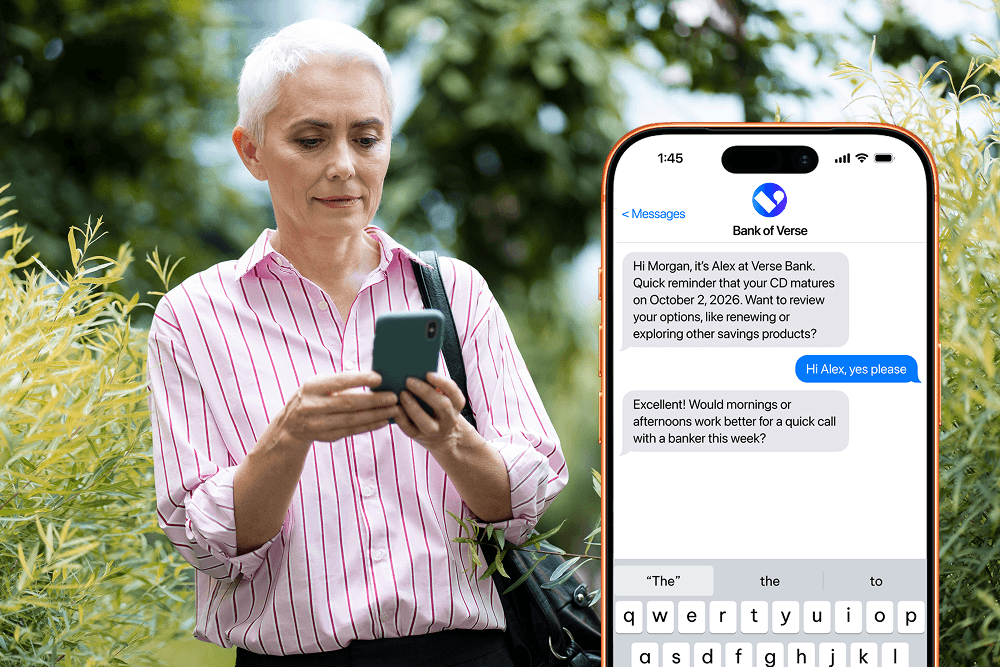
- Product offers timed to life events or milestones, such as a maturing CD
- Satisfaction surveys followed by review requests for happy customers
- Fraud alerts sent straight to customers’ most-used device: in an American Bankers Association survey, 96% of customers who received a fraud alert from their bank found it valuable.
SMS compliance for banks
Banks text under overlapping rules from the FCC, mobile carriers, and banking regulators. Please note, this section is general information, not legal advice.
Here are some key SMS compliance points that banks must be aware of:
- Marketing texts need prior express written consent. Informational texts, such as payment reminders, appointment confirmations, and fraud alerts, need prior express consent, which a customer gives by providing their number for that purpose.
- Opt-in language should include your business name, a message and data rates disclosure, links to your terms and privacy policy, the reason you’re texting, and opt-out instructions.
- Opt-outs must work. Customers can revoke consent by any reasonable means. Keywords such as STOP, END, CANCEL, UNSUBSCRIBE, and QUIT should work automatically, and requests must be honored within 10 business days.
- State laws add rules. “Mini-TCPAs” in states including California, Florida, New York, and Washington apply to anyone physically in the state and can restrict texting hours.
- Scrub against the Do Not Call registry regularly.
- Watch banking vocabulary. Words like “urgent” and “cash” can trigger carrier spam filters, though context matters most. Write plainly and avoid exaggerated claims.
- Protect nonpublic personal information. Gramm-Leach-Bliley privacy rules apply, so keep account numbers and SSNs out of texts and send customers to a secure portal.
- Separate transactional and promotional programs. Run fraud alerts and account notices apart from marketing, so a marketing opt-out doesn’t silence messages customers need.
- Use a consistent number, link only to your verified domain, and tell customers at opt-in what you will never ask for. As text scam attempts continue to rise, retaining trust is paramount.
- Vet your SMS vendor. The 2023 interagency guidance on third-party risk applies to all banking organizations supervised by the Fed, FDIC, and OCC, and covers due diligence through ongoing monitoring.
Verse’s SMS solution supports each of these points through our compliance suite and dedicated compliance team.
Driving outcomes with SMS
Here’s a quick checklist to start with two-way SMS for banks.
- Secure prior consent: Remember, marketing texts require express written consent under the TCPA, plus a clear opt-out that you process promptly. Tell customers at opt-in which message types they’re agreeing to, and have counsel review your program. See here for a full SMS compliance checklist.
- Keep sensitive data out of texts. Send customers to a secure portal for anything involving account details or documents.
- Segment and personalize. Use lead source, product interest, and journey stage so each message fits the person receiving it.
- Write like a person. Keep texts short (under 320 characters tends to perform best), use first names, and end with a clear question.
- Reply fast. Aim for five minutes or less. Automation can cover nights and weekends.
- Hand off at the right moment. Let automation handle first response and qualification, then route ready prospects to a banker by text or live call transfer.
- Track performance over time. Monitor reply rate, qualification rate, appointments set, application completion, opt-out rate, and CSAT. A/B test message copy and timing.
Start texting customers the easy way
While two-way SMS is ideal, most banks lack the staff to text every customer within minutes, around the clock.
Verse is a fully-managed conversation platform that handles two-way texting for you.
Verse engages new leads instantly, qualifies them through natural conversation, and books appointments for your team. Compliance guidance is built in—even for tightly-regulated industries like financial services and banking—and everything syncs to your CRM. Human handoff is seamlessly integrated into the platform.
Ready to see what Verse can do for you? Book a personalized demo today.