


No-shows are a routine and ongoing drain on healthcare revenue and provider time. Missed appointments cost the U.S. healthcare system hundreds of billions per year.
While national no-show rates vary widely by specialty and setting, a peer-reviewed study across 10 outpatient clinics found a mean no-show rate of 18.8%, ranging from 12.6% in audiology to 25.7% in gastrointestinal care. A separate systematic review put the overall mean closer to 15.2%.
When applied across a full patient schedule, even a 10% no-show rate can cost a single practice hundreds of thousands—even over a million—in one year.
Standard appointment reminders can help, and are often already in place. However, conversational SMS goes further. Two-way texting gives patients an immediate, low-effort way to confirm, reschedule, or ask a question, right in the moment they’re deciding whether they’ll actually show up. Whether the appointment is a dental cleaning, a primary care visit, a plastic surgery consult, or a physical therapy session, the hassle that causes a no-show looks the same across practice types, even when the appointment itself doesn’t.
This post covers what conversational SMS means for healthcare providers and medical practices, why it outperforms traditional reminders for reducing no-shows, and what to look for in a texting solution.
What is conversational SMS?
Conversational SMS is two-way text messaging that lets a patient reply in their own words and get a relevant, immediate response. It differs from traditional one-way messages and reminders because it allows a back-and-forth conversation in real time.
A standard appointment reminder tells a patient about their upcoming visit and stops there. If the patient can’t make it, they still have to call the office to reschedule—which reintroduces the exact obstacles (hold times, business-hour limitations, phone tag) that made texting appealing in the first place.
Human representatives or AI agents can use conversational SMS to engage with patients, or even a combination of the two. AI texting agents (like Verse) can easily support scheduling through context-aware, accurate responses that leverage national language understanding and natural language processing to serve patients intelligently.
A text blast can remind a patient about an appointment, but it can’t respond when that patient wants to change it. Conversational SMS can.
Here’s an example text-based appointment rescheduling flow:
- A patient can reply to a reminder with something like, “I can’t make Tuesday, do you have anything Thursday afternoon?”
- The system interprets that reply, checks real appointment availability, and offers a new time — or hands the conversation to a staff member if needed.
- The change gets reflected directly in the practice’s scheduling system, without a staff member manually managing the exchange.
Why patient no-shows are a bigger problem than they appear
No-show rates get treated as background noise in a lot of practices, but data shows that they are a significant drain on medical practices and providers nationwide.
- No-show rates across outpatient care commonly range from 5% to 30% or higher, depending on specialty and patient population (Source: PMC)
- In a study across 10 outpatient clinics, primary care carried the highest overall visit volume and, as a result, the highest total number of no-shows—an average of about 33,098 missed visits per year (Source: PMC)
- Missed appointments cost the U.S. healthcare system an estimated $150 billion annually, and a single no-show costs a practice roughly $200 (Source: DialogHealth).
- 42% of incoming calls to medical practices during business hours go unanswered, and roughly 80% of appointments are still scheduled and rescheduled by phone. (Source: AnswerNet)
If rescheduling requires a phone call, and a meaningful share of calls go unanswered, some portion of patients who would have rescheduled simply don’t show up instead. Appointments are never rescheduled and care is never received because the rescheduling process is clunky and time-consuming for the patient.
This shows up across every kind of practice, not just hospitals and large health systems. A dental office managing recall and cleaning appointments, a primary care practice juggling same-day and follow-up visits, a plastic surgery or med spa practice relying on consult-to-procedure conversion, and a physical therapy clinic depending on patients completing a full course of recurring sessions all face the same underlying issue: a missed appointment doesn’t just cost that one visit, it disrupts a schedule and, in PT’s case, can interrupt an entire treatment plan.
Missed appointments snowball into lost revenue and wasted time, with a financial impact that compounds quickly. Even small reductions in no-show rate can recover meaningful amounts of revenue over time.

How conversational SMS reduces patient no-shows
The evidence for text-based reminders alone is already strong. A systematic review of 29 studies found automated appointment reminders cut non-attendance by a weighted average of 29% and a Cochrane review found attendance rising from 67.8% with no reminder to 78.6% with a text reminder (an 11-point improvement).
Texting itself carries a distinct advantage over other channels here: SMS sees open rates around 98%, and in a PMC study, 91% of patients said text messages help them avoid making unnecessary calls to their provider altogether.
Two-way texting for healthcare builds on that reminder effect in three ways.
Confirmations and easy rescheduling
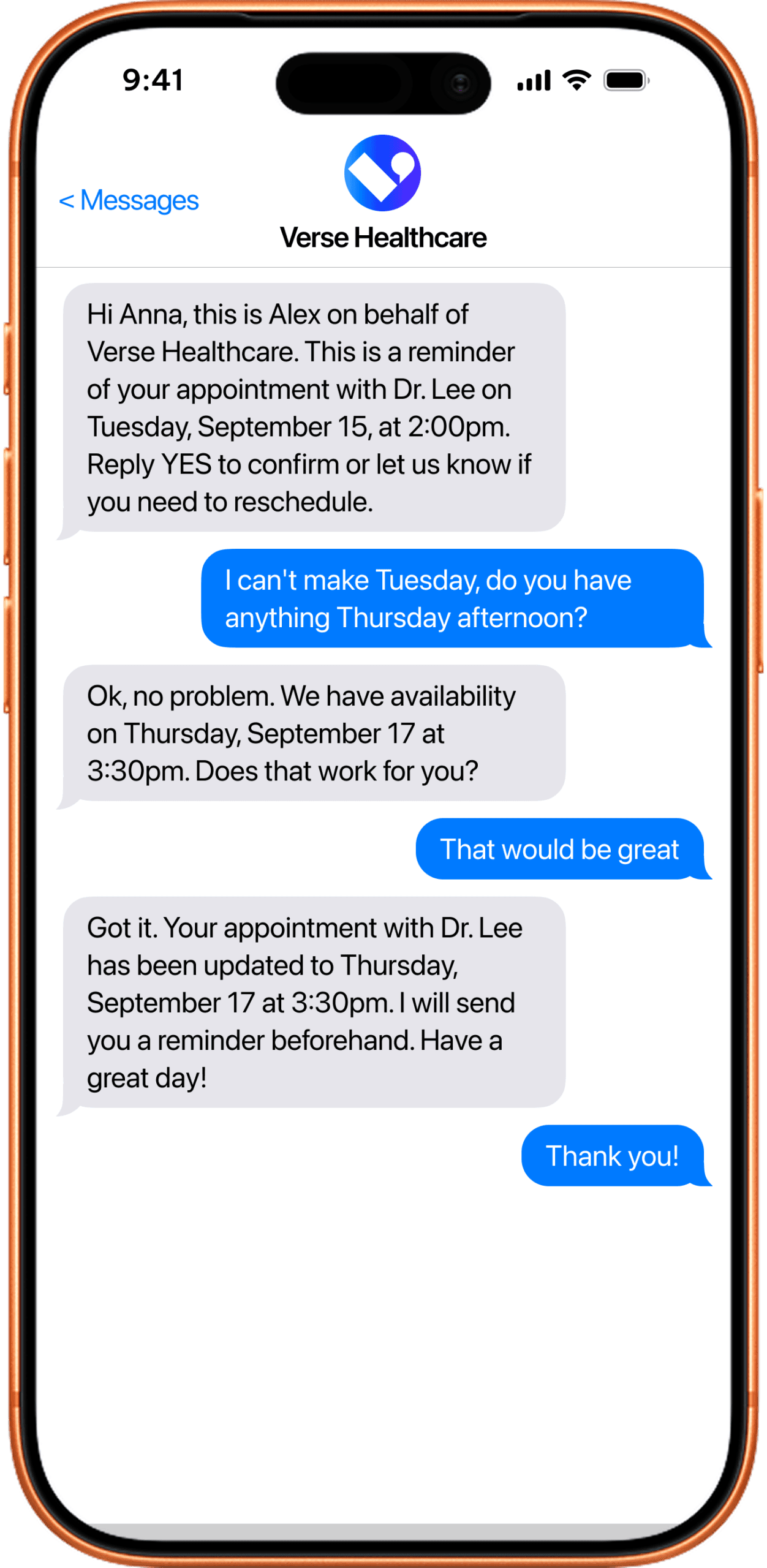
Instead of a reminder that simply states the appointment time, a conversational message can ask the patient to confirm or reschedule directly. A patient who’s on the fence about attending has an immediate, low-effort way to say so (and get a new time) right from their phone, instead of needing to remember to call during business hours.
A simple version of this exchange looks like:
- The practice sends a reminder: For example, “This is a reminder of your appointment with Dr. Lee on Tuesday at 2:00pm. Reply YES to confirm or let us know if you need to reschedule.”
- The patient replies: For example, “I can’t make Tuesday, do you have anything Thursday afternoon?”
- The system interprets the request, checks real provider availability, and offers a specific new time rather than asking the patient to call in.
- The patient confirms the new time by text, and the change is reflected directly in the practice’s scheduling system.
- If the request is more complex, and needs human expertise, the conversation is handed off to a person with the conversation history immediately available.
Proactive outreach for at-risk appointments
No-show risk isn’t evenly distributed: new patients, patients with a history of cancellations, and appointments booked far in advance have all been shown to carry higher no-show risk than a returning patient confirming a visit booked the week before.
A conversational system can apply extra follow-up for non-responsive patients with a high no-show risk. For example, it can add extra check-in a few days before the appointment, a ringless voicemail drop, and a second reminder the morning of.
Because AI texting supports real back-and-forth, a practice can follow up with patients who haven’t confirmed as the appointment approaches, rather than sending a single reminder and hoping for the best. This matters most for the patients who are statistically most likely to miss their visit in the first place.
Reducing administrative load
From dental offices to physical therapy practices and primary care offices, healthcare teams are stretched thin everywhere. The last thing they need is more administrative tasks.
But, every rescheduling request that has to go through a phone call adds friction for the patient and workload for staff. When a practice already has 42% of business-hour calls going unanswered, adding text-based self-service not only improves the patient experience, but the employee experience, too.
Self-serve scheduling reduces the odds that a patient trying to reschedule gets stuck at a busy signal or a full voicemail box and simply doesn’t follow through at all.
What to look for in a conversational SMS solution for healthcare
Not every texting tool is built to handle complex workflows and the specific needs of a healthcare practice. When evaluating a conversational SMS solution, healthcare or medical practices should look for:
- HIPAA and TCPA compliance built into the platform, including how protected health information (PHI) is handled if any health information appears in a conversation.
- Strong integration with the practice’s scheduling system or electronic healthcare record (EHR), so a confirmed reschedule updates the calendar in real time.
- Controlled, accurate AI that sticks to approved information and human hand off triggers.
- A clear escalation path and live transfer to a human for patients who need more than a scheduling change.
- Visibility into no-show trends by provider, location, or appointment type, so a practice can tell whether the approach is actually working.
- Support across the full patient journey: the same conversational capability can apply to new-patient inquiries and intake, so ensure the solution can work for additional use cases if needed.
A platform that handles reminders well but can’t hold a real two-way conversation, integrate with existing systems, or maintain compliance standards will only solve part of the no-show problem. In healthcare specifically, the parts it doesn’t solve tend to be the ones with the most regulatory and reputational risk attached.
For a deeper look at compliance, data privacy, and consent requirements specific to healthcare texting, see this blog.

Prevent patient no-shows with Verse’s AI texting
Verse’s AI agents help healthcare organizations and medical practices of all sizes and types manage responsive text conversations at scale.
With AI-powered conversational SMS, Verse allows patients to schedule, reschedule, confirm, or cancel appointments conveniently from their smartphones, 24/7/365—helping providers reduce no-shows, administrative load, and provide a better patient experience.
Verse can be applied across the patient journey, from initial engagement to asking questions, sending reminders, and routing conversations across channels. Our platform also includes an AI digital web assistant for websites, ringless voicemail delivery, and AI voice and live transfer capabilities to streamline phone conversations.
Ready to see how Verse can help you reduce patient no-shows? Book a demo today.